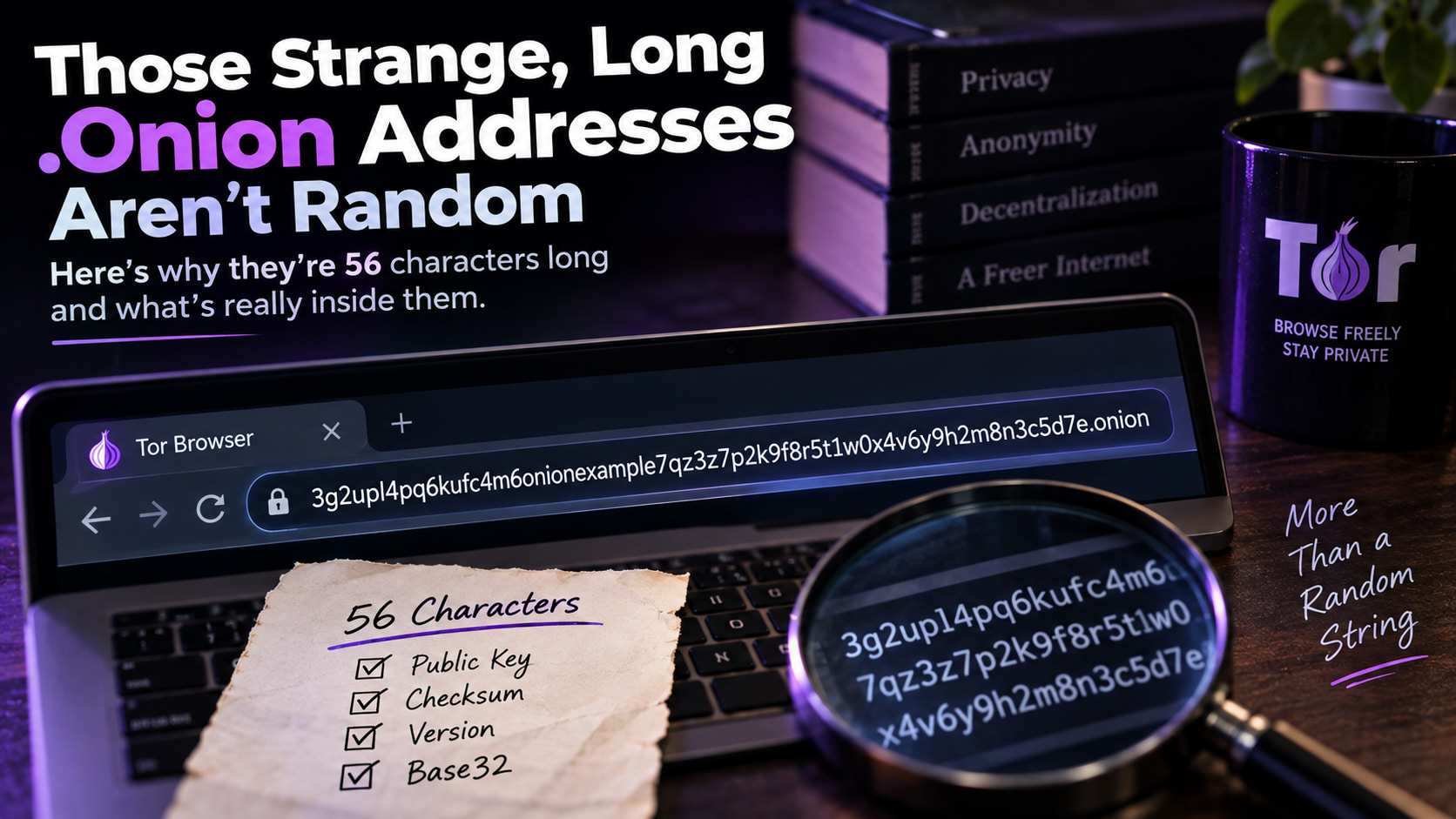
Those Strange, Long .Onion Addresses Aren’t Random
If you’ve ever come across a modern .onion address, you probably noticed something immediately: it’s extremely long.
Unlike familiar web addresses such as Google.com or Wikipedia.org, an onion address looks like a long and confusing combination of letters and numbers. To someone seeing one for the first time, it can look almost impossible to remember—and completely random.
But there is a reason for that.
An onion address isn’t designed to work like a traditional domain name. Instead of choosing a simple name and registering it through the conventional domain-name system, a modern onion service gets an address that is connected to its cryptographic identity.
That difference is a big part of what makes onion services unique.
So why are modern onion addresses 56 characters long? What information is actually contained in those characters? And why were older onion addresses much shorter?
To understand that, we first need to look at what an .onion address actually is.
What Is a .Onion Address?
A .onion address is a special type of address used to reach an onion service through the Tor network. A .onion address is a special type of address used to reach an onion service through the Tor network, as explained in the Tor Project’s Onion Services documentation.
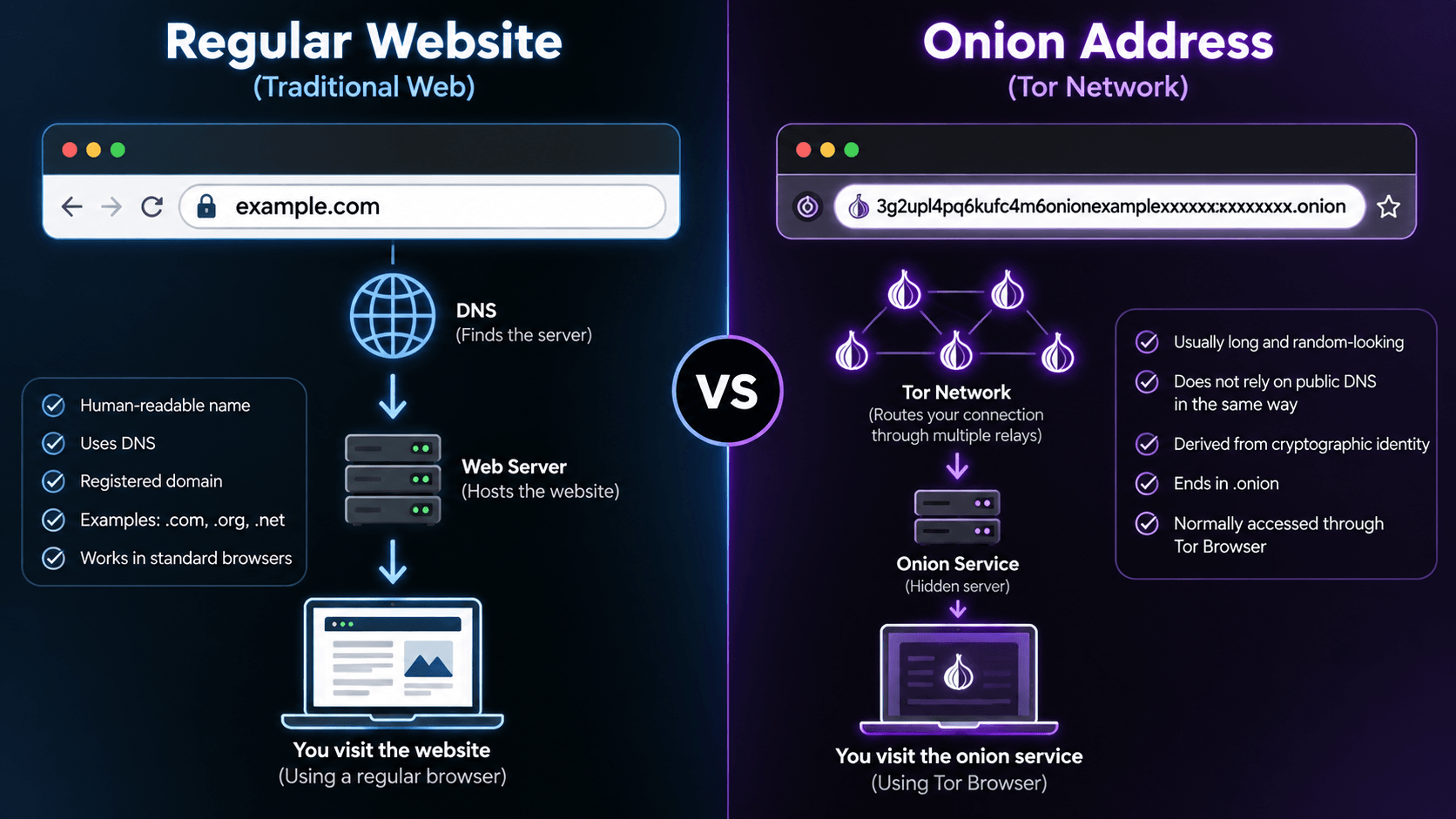
On the regular web, websites commonly use domains ending in extensions such as .com, .org, or .net. These domain names rely on the traditional Domain Name System, better known as DNS, to help browsers locate the servers hosting those websites.
Onion services work differently.
The .onion ending is a special-use domain, and onion addresses are resolved through the Tor network rather than through the public DNS system used by ordinary websites. Because of this, entering an onion address into a typical browser such as Chrome or Safari normally won’t work the same way as entering a regular website address.
Tor Browser is specifically designed to recognize these addresses and connect to onion services through Tor.
There is another important difference.
A conventional domain name is usually chosen because it is easy for people to recognize and remember. An onion address, however, is derived from cryptographic information associated with the onion service.
That’s why an address can look something like this:
xxxxxxxxxxxxxxxxxxxxxxxxxxxxxxxxxxxxxxxxxxxxxxxxxxxxxxxx.onion
The long sequence isn’t simply there to make the address mysterious or difficult to read. Modern onion addresses use a specific format, and their length is closely connected to the security design behind today’s onion services.
That brings us to the obvious question.
Why Are Modern Onion Addresses 56 Characters Long?
Modern onion services use what are commonly known as v3 onion addresses.
The part before .onion contains 56 characters, made from lowercase letters and the numbers 2 through 7. Those characters are a Base32 representation of information associated with the onion service.
Importantly, the 56 characters are not just a randomly selected website name.
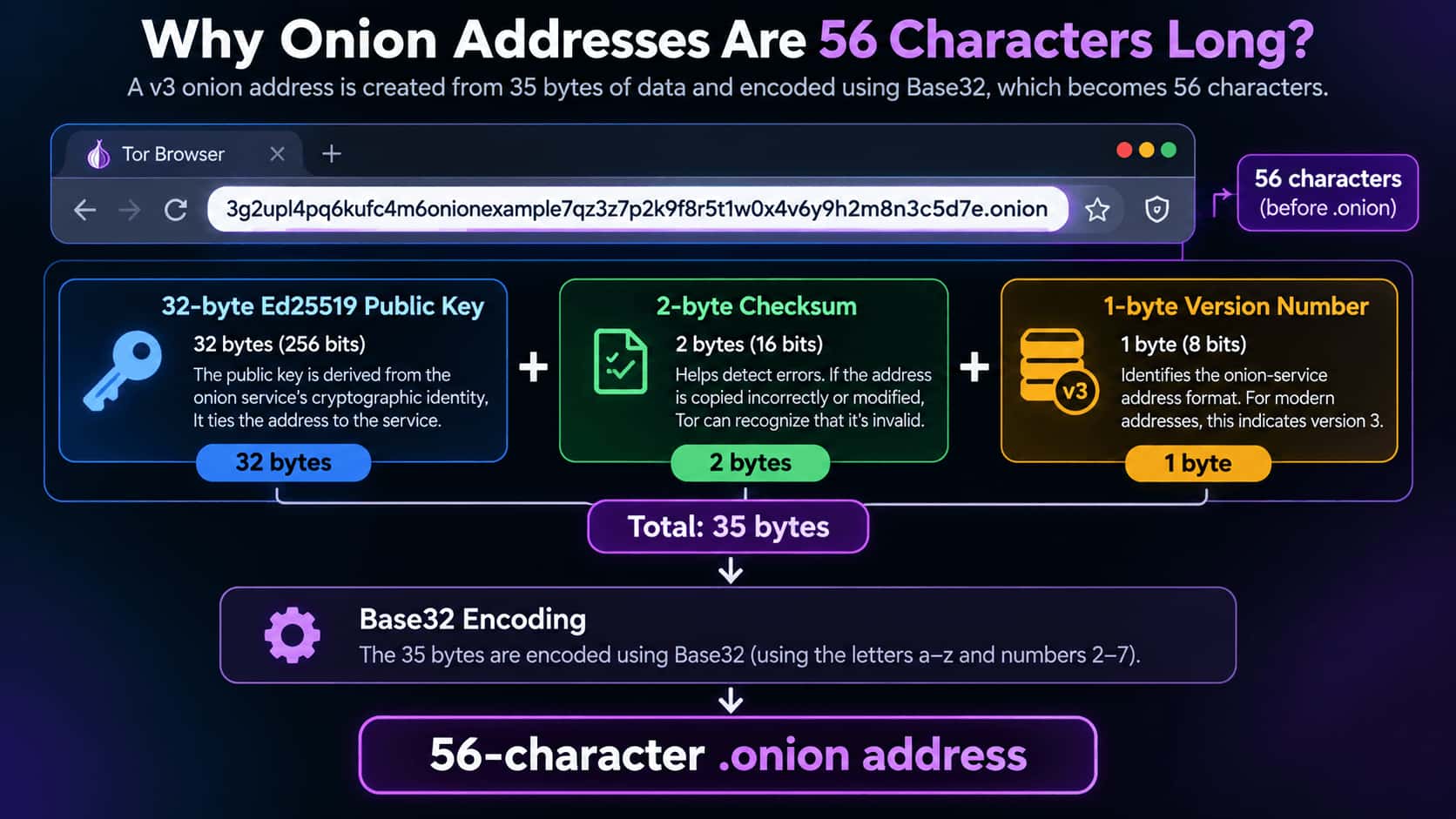
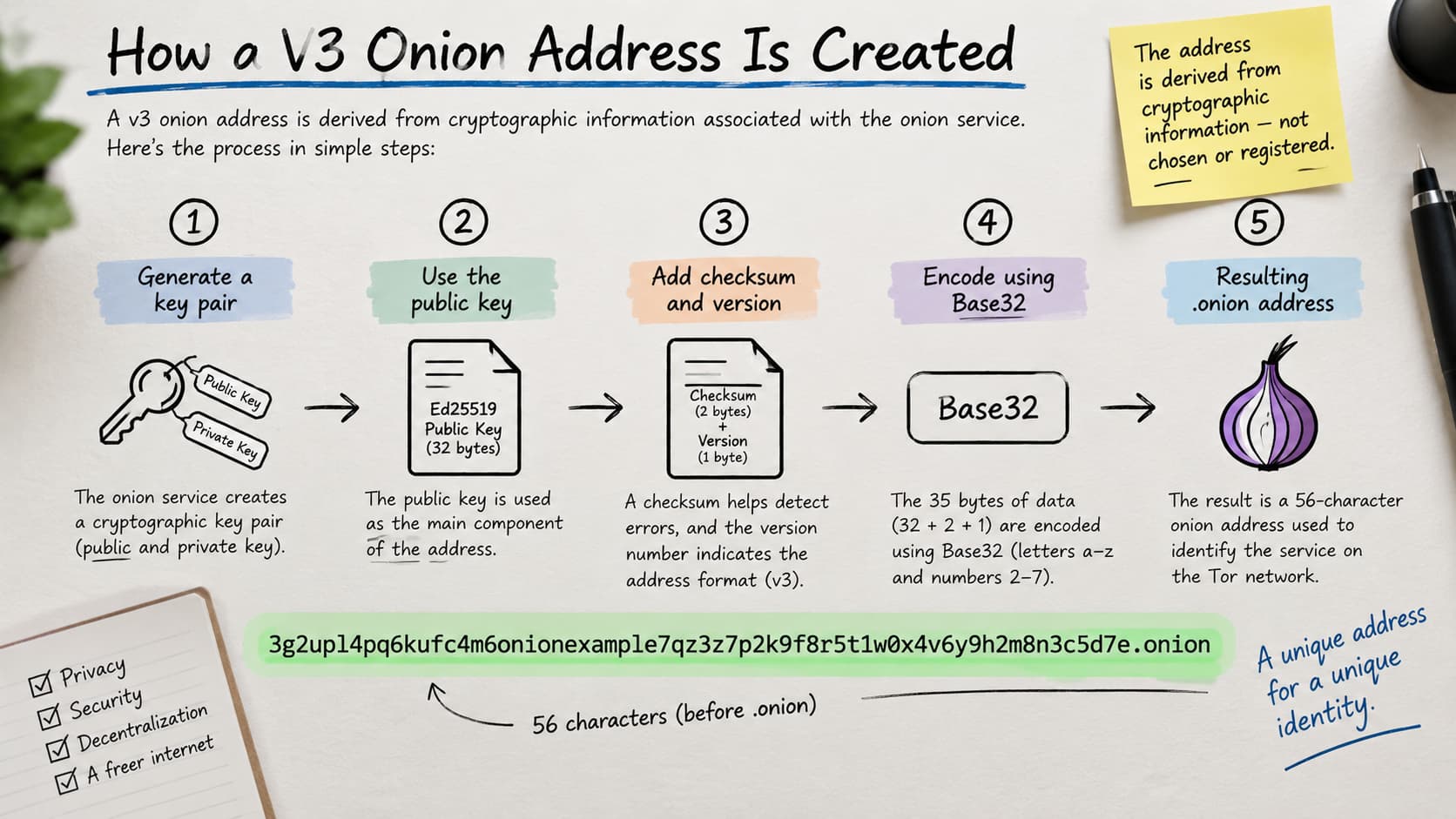
A v3 onion address encodes three components:
- A 32-byte Ed25519 public key
- A 2-byte checksum
- A 1-byte version number
Together, that’s 35 bytes of information. Encoding those 35 bytes using Base32 produces the familiar 56-character onion address.
The public key is especially important because it ties the address to the onion service’s cryptographic identity.
This is fundamentally different from a regular domain.
If someone wants a conventional website called example.com, they can attempt to register that domain through a domain registrar. The name itself doesn’t cryptographically prove the identity of the server behind it.
With a modern onion service, the address is mathematically derived from cryptographic information belonging to that service.
So those 56 strange-looking characters aren’t wasted space.
They are part of how the onion service identifies itself.
What Information Is Inside a V3 Onion Address?
A modern v3 onion address may look like a meaningless collection of characters, but there is actually a specific structure behind it.
The 56 characters before .onion are created from 35 bytes of data. That data contains three main components: a public key, a checksum, and a version number.
The largest part is the 32-byte Ed25519 public key. This public key is connected to the onion service’s cryptographic identity. In simple terms, it helps make the address itself closely tied to the service rather than being an ordinary name selected by the website owner.
Next comes a 2-byte checksum.
A checksum is a small piece of data used to help detect whether an address is valid. If an onion address is copied incorrectly or altered, the checksum helps Tor recognize that something isn’t right.
Finally, there is a 1-byte version number. This identifies which version of the onion-service address format is being used. For today’s v3 addresses, that value indicates version 3.
These components can be summarized simply:
32-byte public key + 2-byte checksum + 1-byte version = 35 bytes
Those 35 bytes are then encoded using Base32, producing the 56 characters that appear before .onion.
So although a modern onion URL looks random to a human reader, its length isn’t arbitrary. The address carries information that helps Tor identify and validate the onion service.
Why Did Old Onion Addresses Used to Be Much Shorter?
If you’ve been reading about the dark web for a long time, you may remember onion addresses that looked considerably shorter.
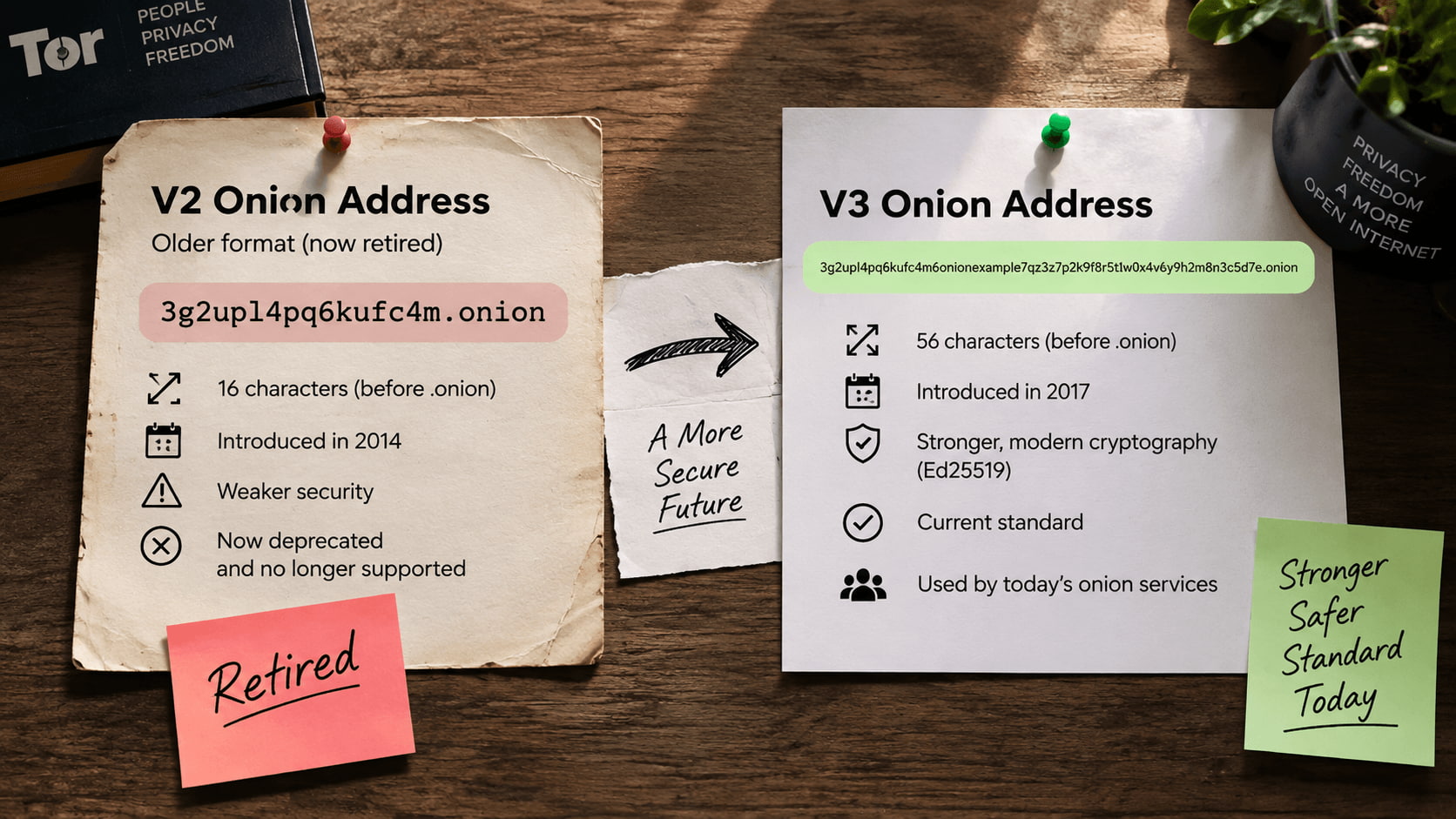
That’s because older v2 onion services used 16-character addresses.
They looked much more manageable compared with today’s 56-character v3 addresses. As a result, you can still find old screenshots, forum posts, articles, archived webpages, and outdated onion directories containing these shorter addresses.
However, shorter didn’t mean better.
The old v2 system was based on an earlier onion-service design and older cryptographic choices. As Tor evolved, the project developed a newer onion-service protocol with stronger security properties and a more modern design.
That’s where v3 onion services came in.
A v3 address is substantially longer because considerably more cryptographic information is represented in the address. Instead of the old 16-character format, a modern v3 address contains 56 characters before .onion.
This also explains why some very old onion links you find online no longer work.
If you encounter a 16-character .onion address in an old article, it is likely a v2 address rather than a modern onion address.
Why Tor Replaced V2 Onion Addresses With V3
The move from v2 to v3 wasn’t made simply to give onion sites longer URLs.
It was part of a broader redesign of Tor’s onion-service technology.
V3 onion services introduced a newer cryptographic design, including Ed25519 keys, and addressed weaknesses and limitations associated with the older system. The newer design also improved how onion services protect and establish their identities.
One of the most visible consequences of that change is the address length.
V2: 16 characters + .onion
V3: 56 characters + .onion
Tor began introducing the newer generation of onion services years before eventually retiring support for the old format. V2 onion services were deprecated, and support for them was subsequently removed from Tor.
That distinction matters when browsing older dark-web content today.
An article from years ago might contain perfectly authentic onion links for the time it was published, yet those links may now be unusable simply because they belong to the retired v2 system. The service itself may have moved to a new v3 address—or it may have disappeared completely.
This is one reason old onion links become outdated so easily, and why checking when an onion-related article or directory was last updated can be important. V2 onion services were deprecated, and support for them was subsequently removed from Tor, as detailed in the Tor Project’s V2 Onion Services deprecation documentation.
Most importantly, the transition demonstrates something that’s easy to miss when looking at an onion URL:
The extra length of a modern onion address isn’t cosmetic. It’s a consequence of the cryptographic design used by modern Tor onion services.
Why Can’t Onion Sites Just Use Simple Names Like Normal Websites?
At first, it might seem unnecessarily complicated.
Why use an address containing 56 difficult-to-remember characters when a normal website can have something simple like example.com?
The answer comes down to how the two types of addresses are created and managed.
A traditional domain name is registered through the regular domain-name system. A website owner can search for an available name, register it through a domain registrar, and configure DNS records that point visitors toward the appropriate server.
That allows conventional websites to use recognizable names such as:
example.com
An onion address works differently.
There isn’t a traditional .onion registrar where someone simply searches for a short name, pays a registration fee, and receives that exact address.
Instead, a v3 onion address is derived from cryptographic information associated with the onion service. As we discussed earlier, its public key forms the main component of the address.
That produces something that looks more like:
xxxxxxxxxxxxxxxxxxxxxxxxxxxxxxxxxxxxxxxxxxxxxxxxxxxxxxxx.onion
This difference is important.
A regular domain is primarily a human-readable name registered within the DNS ecosystem. A modern onion address also functions as part of the service’s cryptographic identity.
That is why making every onion address short and memorable like an ordinary .com domain would conflict with the way modern onion addresses are designed.
You may occasionally encounter onion addresses whose beginning spells a recognizable word or brand. These are often called vanity onion addresses. They can be generated by searching through many possible cryptographic keys until one produces the desired prefix.
However, only part of the address is typically customized this way. The underlying v3 address still follows the same 56-character format.
How Is an Onion Address Created?
You don’t need to understand advanced cryptography to understand the basic idea behind creating an onion address.
Conceptually, the process can be viewed in three stages:
Cryptographic key pair → Onion-service identity → .onion address
When an onion service is created, it has a cryptographic private key and public key.
The private key needs to remain secret because it is an essential part of the service’s identity. The corresponding public key can be used as part of the information from which the onion address is derived.
For a v3 onion service, Tor takes the required cryptographic information—including the public key, checksum and version information—and encodes it into the familiar 56-character format.
The result becomes the service’s .onion address.
This creates an interesting relationship between the address and the service.
With a conventional website, an organization could change hosting providers or server infrastructure while continuing to use the same registered domain.
An onion service can also change infrastructure while preserving its onion address, provided the cryptographic identity associated with that address is preserved.
On the other hand, if a completely new onion-service identity is generated, it will normally produce a different onion address.
So the long URL isn’t simply a location written in an inconvenient format. It is closely connected to the cryptographic identity behind the onion service. The corresponding public key can be used as part of the information from which the onion address is derived, which is explained further in the Tor Project’s Onion Services overview.
Can Two Onion Websites Have the Same Address?
Under normal circumstances, two independently created onion services should not end up with the same legitimate v3 onion address.
The reason goes back to the public key.
Because a v3 onion address is derived from the service’s cryptographic identity, independently generated key pairs produce different addresses.
For two unrelated services to independently generate exactly the same valid 56-character address would require an extraordinarily improbable cryptographic collision.
In practical terms, this isn’t something users should expect to happen by accident.
There is an important distinction, though.
Someone can copy the text of another website’s onion address and publish it somewhere else. That doesn’t give them control of the real onion service behind that address. Operating the service as that cryptographic identity requires the corresponding private key.
This is one reason protecting an onion service’s private key is so important. If that key were compromised, the problem would be much more serious than someone simply copying the URL.
For everyday users, there’s a simpler lesson:
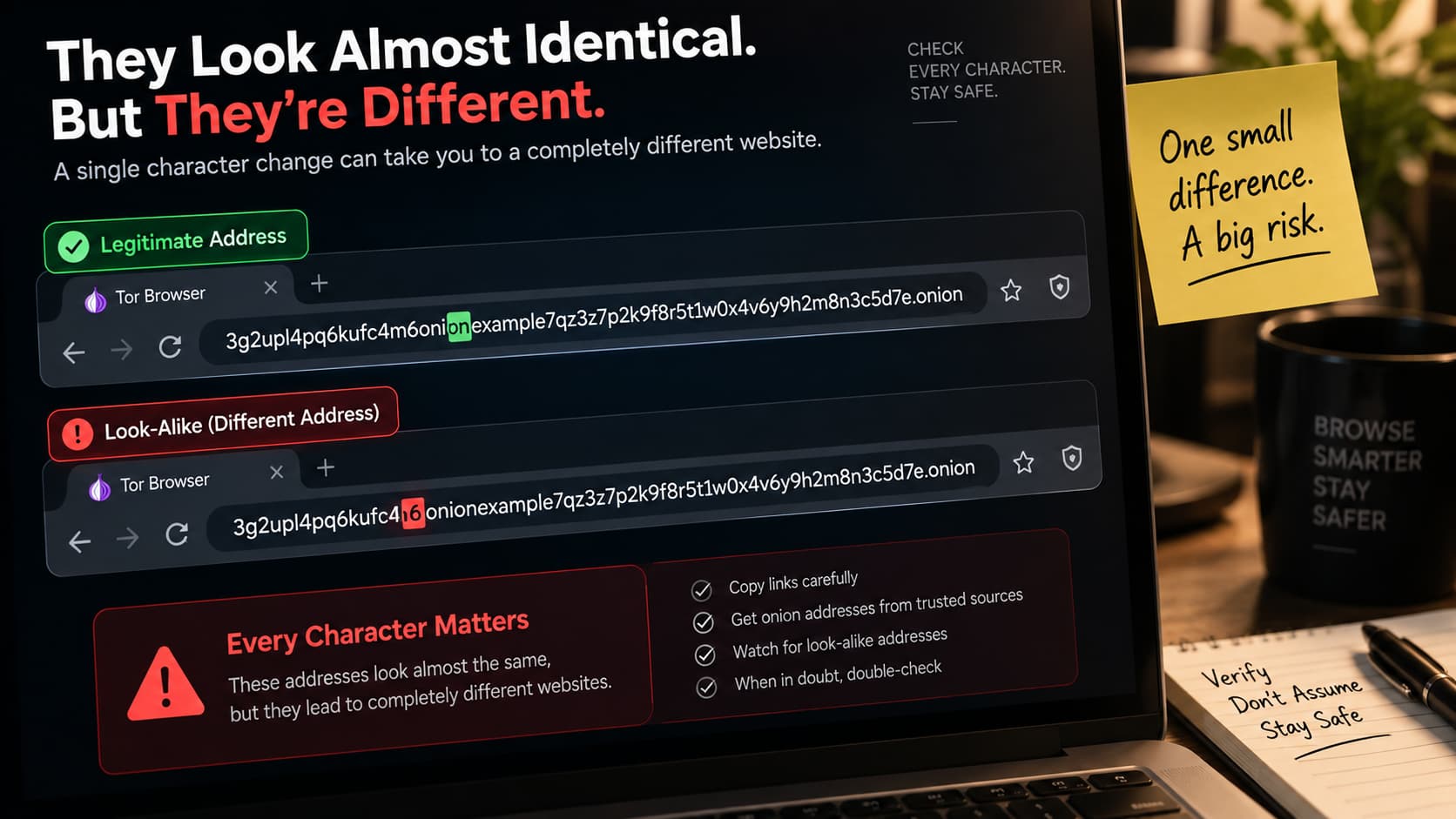
Similar-looking onion addresses are not necessarily the same address.
With 56 characters packed together, it can be difficult to notice a small difference. A link that looks almost identical to a legitimate address could still lead somewhere entirely different.
That makes verifying onion addresses particularly important—which we’ll look at more closely below.
Can You Tell Who Owns a Website From Its Onion Address?
Looking at an onion address alone generally won’t tell you who owns or operates the website behind it.
A normal domain can sometimes provide clues about the organization running it. A company may use its brand name in the domain, publish contact information, or have registration and business records that connect the website with a real-world organization.
An onion address doesn’t work that way.
As we’ve seen, a modern v3 onion address is derived from cryptographic information associated with the onion service. The characters themselves don’t contain a person’s name, company name, physical location, email address, or other conventional ownership information.
In other words, you cannot decode a 56-character onion address and discover something like:
Owner: John Smith
Server: New York
Company: Example Inc.
That information simply isn’t encoded into the address.
This is also related to one of the important properties of onion services: visitors can connect to a service without the service needing to reveal its server’s IP address in the same way an ordinary public website does.
However, that should not be interpreted as meaning an onion service is automatically anonymous in every possible situation. An operator could reveal identifying information themselves, make configuration mistakes, use identifiable accounts elsewhere, or publicly associate an onion address with their organization.
In fact, some legitimate organizations intentionally publish their onion addresses on their regular websites so visitors can verify that the onion service actually belongs to them.
So an onion address provides a cryptographic identity for the service, but by itself it doesn’t tell you the real-world identity of the person or organization operating it.
Why You Should Be Careful When Copying Long Onion URLs
The security properties behind onion addresses are useful, but their length creates a very practical problem for users:
56-character addresses are difficult to recognize and verify visually.
Imagine two onion addresses containing dozens of characters with only a few characters changed. At a quick glance, they could appear almost identical.
This creates several potential problems.
A simple copying mistake can result in an invalid address. An old article might contain an onion address for a service that has since disappeared or moved. And an untrusted directory could publish a completely different address while claiming that it belongs to a well-known service.
More seriously, look-alike links can sometimes be used for phishing or impersonation.
A fake website might copy the appearance of another onion service while using a different onion address. Someone who recognizes only the first few characters of the URL could easily overlook the difference. This is also why many darknet users rely on directories to discover and organize onion services; you can read more about why the Hidden Wiki can be useful for darknet users.
For that reason, you shouldn’t judge an onion link simply because its address looks similar to one you’ve seen before.
When a known organization operates an onion service, one of the better ways to verify the address is to obtain it directly from the organization’s official website or another source controlled by that organization.
It’s also worth being cautious with very old lists of onion links. Onion services can disappear, change addresses, or become outdated, meaning a link copied from an article published years ago may no longer represent the service you expect.
Long onion addresses may be inconvenient to read, but when you’re dealing with them, every character matters.
What Happens If One Character of an Onion Address Is Wrong?
With an address containing 56 characters, making a one-character mistake sounds surprisingly easy.
So what happens if you do?
It depends on the change, but in many cases Tor will simply be unable to reach the intended onion service.
Remember that a v3 onion address contains more than the public-key-derived component. It also contains checksum and version information. These help Tor determine whether an address follows the expected format.
If you accidentally change one character, the resulting address will generally no longer represent the onion service you intended to visit and may fail validation altogether.
But there is another reason not to rely on an error message for protection.
A different correctly formed onion address can belong to an entirely different service. If someone gives you a valid but incorrect address, Tor cannot know that you intended to visit another website. From Tor’s perspective, you asked it to connect to the address you entered.
That’s why verifying the entire onion address matters.
It also helps explain a common experience among people exploring older onion resources: clicking several links only to find that many of them don’t open.
A mistyped address is only one possible explanation. Onion services can also shut down, change their addresses, experience temporary outages, or disappear permanently.
We’ve covered those reasons in more detail in our “Why the Dark Web Has So Many Dead Links” article, which explains why old onion directories can accumulate unavailable links over time.
So if an onion link doesn’t work, it doesn’t automatically mean Tor itself is broken.
The address could be incorrect, outdated, or the onion service behind it may simply no longer be available.
Onion Addresses vs Regular Website URLs
At first glance, both regular website URLs and onion addresses serve the same basic purpose: they give you an address that can be used to reach an online service.
Behind the scenes, however, they work very differently.
A traditional website typically uses a domain name registered through the conventional domain system. When you enter that domain into your browser, DNS helps direct your browser toward the server associated with it.
An onion address doesn’t depend on the public DNS system in the same way. Instead, the address is derived from cryptographic information associated with the onion service, and the connection takes place through the Tor network.
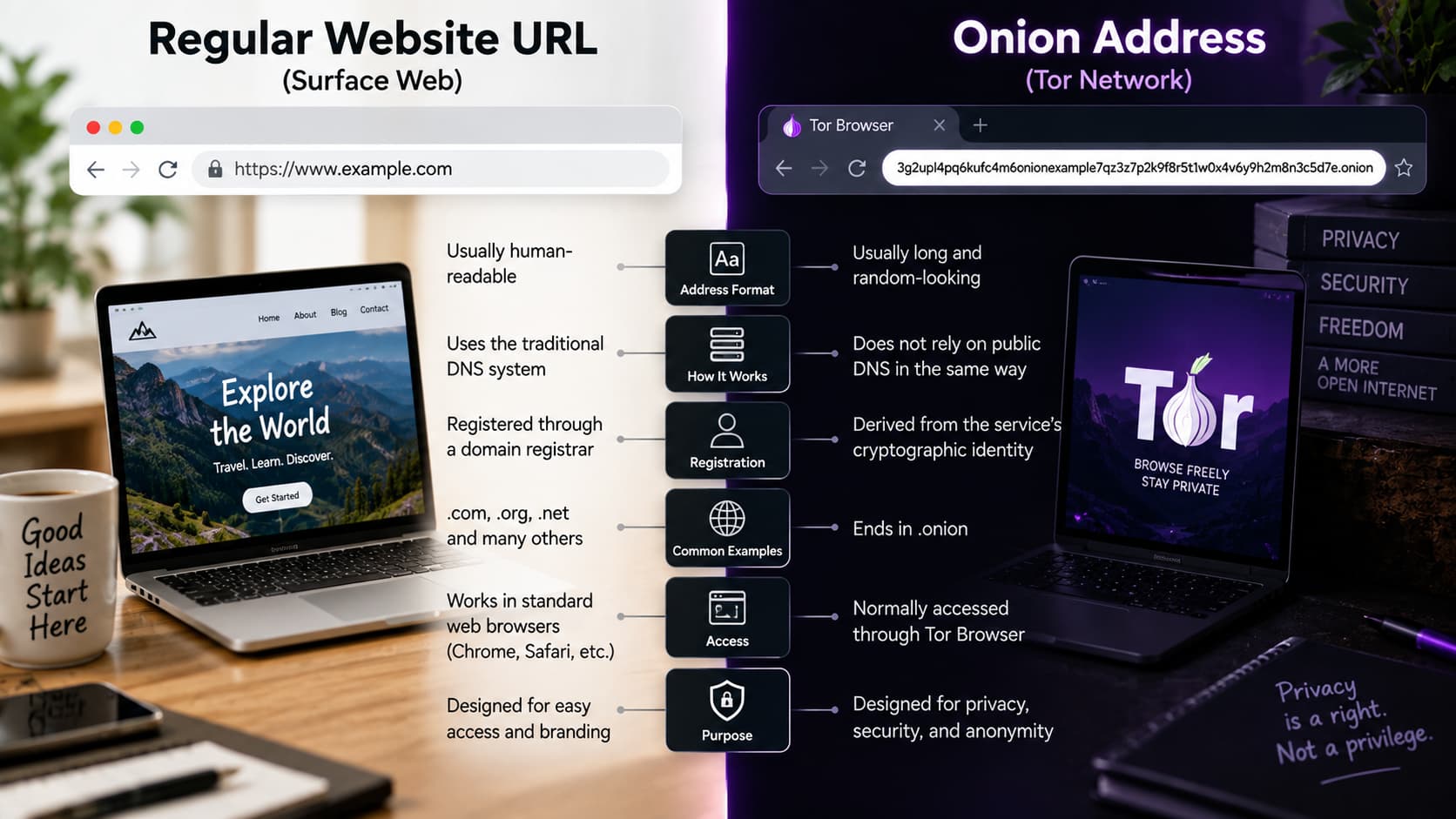
Here is a simple comparison:
| Regular Website Domain | Onion Address |
|---|---|
| Usually designed to be human-readable | Usually long and difficult to memorize |
| Uses the traditional DNS system | Does not rely on public DNS in the same way |
| Domain name is registered | Address is derived from the service’s cryptographic identity |
Common endings include .com, .org, and .net |
Ends in .onion |
| Usually works in standard web browsers | Normally accessed through Tor Browser |
| Can often contain a recognizable brand or organization name | Usually appears as a long string of letters and numbers |
| Domain and hosting can be managed separately | Address is tied to the onion service’s cryptographic keys |
This difference explains why comparing an onion address directly with something like example.com can be misleading.
A conventional domain is designed partly around human-readable naming. You can choose a memorable name, register it, and configure it to point toward your website.
An onion address has a different purpose. Its unusual appearance is a consequence of the cryptographic system behind onion services.
That’s why a 56-character address shouldn’t be thought of simply as an unnecessarily complicated version of a .com domain.
The two address systems were designed differently because they solve different technical problems.
Frequently Asked Questions About Onion Addresses
Even after understanding how onion addresses work, a few common questions often come up. Here are some quick answers about modern .onion addresses and how they differ from ordinary website domains.
How Many Characters Are in a Modern Onion Address?
A modern v3 onion address contains 56 characters before .onion.
Those characters represent encoded information associated with the onion service, including its public key, a checksum, and version information.
This is why today’s onion addresses are much longer than the old v2 addresses, which contained only 16 characters before .onion.
Why Do Onion Addresses Contain Random Letters and Numbers?
The characters may look random, but an onion address isn’t simply a randomly chosen website name.
Modern v3 addresses are created from cryptographic information associated with the onion service and encoded using Base32. Base32 uses the letters a–z and numbers 2–7, which is why those characters repeatedly appear in onion URLs.
Unlike a conventional domain such as example.com, the goal isn’t to create a name that’s easy for humans to remember. The address is connected to the service’s cryptographic identity.
Do Onion Addresses Expire?
An onion address does not have a traditional registration expiration date in the way a .com or .org domain normally does.
There isn’t a conventional domain registrar collecting an annual renewal fee for an onion address.
However, that doesn’t mean an onion service will remain available forever.
The operator can shut down the service, lose the necessary cryptographic keys, abandon the project, or move to a different onion-service identity. This is one reason an onion address found in an old article may no longer work even though the address itself didn’t simply “expire.”
Can an Onion Address Change?
Yes.
If an onion service begins using a new cryptographic identity, it will have a different onion address.
On the other hand, changing the physical server or hosting environment doesn’t necessarily require changing the onion address. If the service securely preserves the cryptographic keys associated with its existing identity, it can potentially continue using the same address.
This is another major difference between thinking of an onion address as merely a server location and understanding it as part of the service’s cryptographic identity.
Can Google or Bing Index .Onion Addresses?
Not in the same way they normally crawl and index websites on the public web.
.onion services aren’t part of the conventional public DNS system and are designed to be reached through the Tor network. Standard search-engine crawlers therefore don’t simply discover and crawl onion services in the same manner as ordinary .com, .org, or .net websites.
However, a normal publicly accessible webpage can mention an onion address, and that regular webpage itself may appear in Google or Bing results. That’s different from the search engine directly crawling and indexing the onion service like an ordinary website.
If you’d like to understand this distinction in more detail, we’ve covered it separately in “How Search Engines Cannot Index the Dark Web.”
Final Thoughts
Those long, unfamiliar .onion addresses may look like random strings at first, but their appearance is not accidental.
Unlike a traditional domain name that is chosen and registered, a modern onion address is closely connected to the cryptographic identity of the onion service. Its 56-character format represents information that helps Tor identify and validate the service users are trying to reach.
That also explains why modern onion URLs are so different from familiar addresses such as .com or .org. They were designed for a different system, with different technical and privacy goals.
The move from shorter v2 addresses to today’s v3 format made onion addresses noticeably longer, but that extra length reflects the newer cryptographic design behind modern Tor onion services.
For users, the practical takeaway is simple: every character in an onion address matters. A mistyped, outdated, or imitation address may fail to connect—or may point somewhere entirely different from where you intended to go.
And when an onion address suddenly stops working, the length of the URL usually isn’t the problem. The service may simply be offline, abandoned, moved, or using a different address.
Understanding how onion addresses and onion URLs work makes the unusual-looking links much less mysterious—and provides a better understanding of how Tor onion services differ from websites on the regular web.